Viniyoga Teacher of the Month
- Feb 23, 2022
- 7 min read
It is a lovely coincidence that the same week I announce my move to work full-time in Yoga therapy and Yoga instruction, the Krishnamacharya Healing Yoga Foundation (KHYF) selects me as Teacher of the Month. Since many of the folks I know don't follow this tradition yet, aren't familiar with KHYF, and certainly don't receive their newsletter, I decided to include that write-up here along with a link to their site. KHYF is the school/clinic in India through which I have been studying for the last 10 years. An international organization based out of India and Singapore, it provides trainings in Yoga, Yoga therapy, and Vedic chant, in addition to providing services for the local and international community in therapy and mentoring.
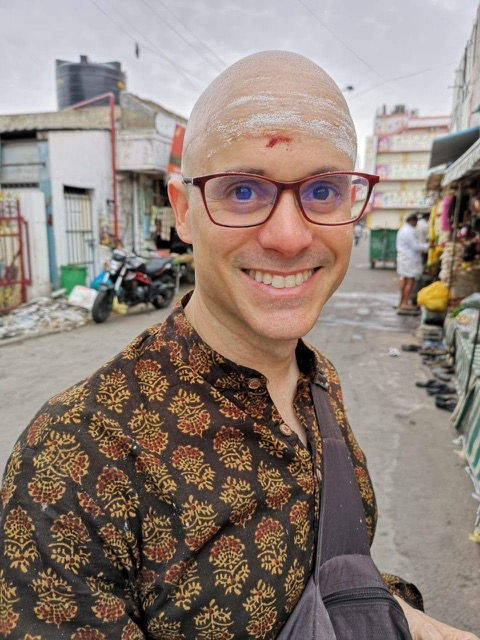
Oreste Prada, California, USA
Salutations, Everyone! First and foremost I would like to thank my mentor, Kausthub Desikachar, and the Krishnamacharya Healing & Yoga Foundation (KHYF) for this spotlight on my teaching.
My name is Oreste Prada and I am a Yoga therapist and Yoga instructor in the Krishnamacharya tradition. I was born in Cuba and now live in San Diego, California, USA. I am registered with the KHYF as a Yoga teacher and Yoga therapist, and I am a Yoga Alliance E-RYT 500-level teacher, the highest registration level for Yoga teachers in the organization, as well as a Continuing Education Provider (YACEP). I am also a certified Yoga Therapist through the International Association of Yoga Therapists (IAYT), the largest Yoga therapy organization in the U.S. My Yoga therapy and Yoga instruction practice is called Crossroads in Focus (www.crossroadsinfocus.com) and alongside the traditional Yoga and Yoga therapy work, I help people in the arts and technical fields apply Yogic techniques like visualization and meditation to help them advance in their career and craft.
It is impossible to overstate the role Yoga has played in my life. I began practice in 2000 as a last resort to manage back pain, and quickly discovered Yoga's subtle yet powerful healing capacity. At the time I was suffering debilitating back pain from an injury and exhaustion from recently diagnosed Chronic Fatigue Syndrome. The back pain would keep me from sitting for more than 30 minutes at a time, which made driving and a desk job grueling, and the episodes of extreme fatigue came monthly and lasted days, disrupting any activity that required energy. I was told by doctors that my back pain could only be remedied through painkillers or surgery. At 26 years old I felt broken. But through the care and attention Yoga practice brought to my body I was able to reduce and eventually eliminate my back pain without either.
Curiously, I noticed that easing my back pain was only the beginning of the healing: the fatigue spells quickly became both less frequent and less severe, something that surprised me, since at the time the Yoga practices I was doing required some physical effort. If anything I expected the fatigue to get worse. But after a year, it all but disappeared entirely, occurring only if I became very sick or very stressed. I would later realize that the latter association hinted both at a common source of disease (disconnection from yourself, which stress all too often causes) and at one of the primary functions Yoga facilitates in healing (reconnecting with yourself).
Since then, I have dedicated myself to daily study and practice of Yoga, mainly focused within the Viniyoga/Krishnamacharya Yoga traditions and with a keen interest on how Yoga can affect our perception, metabolism, and immunity. In 2009 I met T.K.V Desikachar and Menaka Desikachar at a conference they were headlining in San Francisco and the workshops they led were eye-opening. I realized that what I knew about Yoga was only the tip of an enormous iceberg, that there was much to learn and much more depth than I anticipated. I was so excited at the potential to heal within Yoga and soon after went to Chennai to study for the first time with the educational clinic the Desikachars had established.
The month I spent in India exposed me to a myriad of tools that are barely hinted at in most Western Yoga schools. In addition to various approaches to āsana, we learned about Vedic chant, bhāvana, prāṇāyāma, nyāsa, and mudrā. We learned that the diversity of tools, techniques, and approaches in Yoga mirrors the diversity of all people. There are so many possibilities for what Yoga practise can look like, each with its own effect, and each, in the hands of a knowledgable teacher, capable of transforming a practitioner and bringing them back to a connection with their core. It was there that I met my teacher, Kausthub Desikachar, and soon after began studying with him.

In 2015 I began traveling to Chennai twice a year to continue study with the KHYFand formally fulfill the requirements of its teaching and therapy certificates. But the experience offered me so much more. Beyond techniques and knowledge, I was able to experience what it means to be a part of a living tradition, one that has survived more than a thousand years through the dedication of practitioners and through a teacher-student relationship that is held sacred. I had the opportunity to visit thousand-year-old temples closely associated with our tradition, indeed the temple where this lineage began, and to see how the knowledge and focus we apply to therapy is applied to devotion and spiritual pursuits. Because, of course, these are not exclusive realms. The disease that is born out of disconnection with ourselves can manifest physically, mentally, emotionally, or spiritually. Left unaddressed, it may manifest across all of those dimensions. Disease is not simply a strictly physical inconvenience we encounter in our lives as we try to live, eat, work, worship, and play. It is a result of living in a way that is inconsistent with our individual capacity and purpose. It can result from living, eating, working, worshipping, and playing in ways that are detrimental to our constitution, duty, and values. And Yoga has the capacity to help us see and correct disease and suffering by bringing us close to our core so that we can more clearly discern our place, our duty, and our values.
This is not some poetic or philosophical assertion but a very practical and tangible cause and effect relationship, and one we can especially see for many diseases associated with modern lifestyle and diet. In my Yoga therapy practice I am particularly interested in the effects that subtler tools of Yoga have in the endocrine system, and how these tools can assist in managing conditions such as diabetes and hypothyroidism, both closely associated with modern urban life. My research project for my Yoga therapy certificate focused on the different ways Yoga can support patients living with type I versus type II diabetes. The interviews with patients participating revealed surprising similarities among them, despite the varying ages, ethnicities, nationalities, and professions. In working with these participants over many months, we also saw how the approach we took with each needed to vary in order to be effective. Each person had their own needs, despite all of them living with what, from a Western standpoint, would be categorized as the same condition. The same symptoms across various people required a different intervention in order to be effective. This is a tenet of the Viniyoga tradition. The solution always begins with respect for the individual and an acknowledgement that the goal is not to have them adhere to some ideal global standard. We instead find the solution in seeing the person clearly, in understanding their capacity, their potentials, their inclinations, and their obstacles. It is especially important to understand what motivates and inspires them because within that we can begin to see a glimpse of what they feel is their purpose.
Being so expansive in scope, the approach and the tools we use may not look like what many of us in the West would call Yoga. Dr Kausthub Desikachar has relayed many times a beautiful story about how his father once taught a man who was suffering debilitating headaches by having him take photographs of things in the world that showed symmetry. The assignment resolved his headaches. No āsana, no prāṇāyāma… but a much needed change in perception, a Yogic tool nonetheless.
The problems that Yoga can address are not problems we have outside of our families, relationships, careers, hobbies, and crafts. They often manifest their issues precisely within these areas; indeed they are sometimes inherent to these. I have seen this in my own experience as a photography teacher: students who are stuck in seeing things in a particular way and who sense that there is more to explore in their craft. But they can’t quite figure out how. A simple assignment that helps them change the way the see, that requires them to work outside of their typical patterns, suddenly opens them up to so many possibilities they did not consider before. And they, as well as their photographs, are transformed. I have also seen it as a program manager in engineering, where people who are fascinated and dedicated to science and engineering frequently face exhaustion and disillusionment in their work because they lose sight of the importance of work-life balance and a sense of purpose. Many are totally disconnected from the original reason they went into this field. Once a person re-establishes these connections they suddenly have more energy and enthusiasm to get their work done. In some cases, what emerges is the realization that they are due for a change. And this new way of seeing helps them muster the courage to make it.
In my Yoga therapy practice, then, I work with many types of people, among them people who have no interest in getting on a mat but who seek transformation. And, in these cases, what I have learned through the KHYF has allowed me to apply the same concepts, theoretical tools, and goals that we have in Yoga but by using different applications. Sometimes in photography. Sometimes in career decisions. But always with the goal of helping the individual see and remove their own blocks so they can come closer to themselves, make decisions from a place of clarity, and transform their lives so their lives more closely reflect their purpose. This is why I chose the name Crossroads in Focus for my practice: because in our life journey (whether in relationships, careers, hobbies, school, or where we live) we are very often at crossroads, places where we need to make decisions about how and in what direction to proceed. These crossroads can be anxiety inducing, indeed paralyzing, for many people. We have a sense that the wrong choices may lead us to resistance and suffering. The right ones, though, will get us closer to our purpose. Discerning which path to take is not easy but always begins with focus, clarity, and courage. This is the path of Yoga.


Comments